The sister I brought to the book
Two Sisters, One Fast, One Slow
It’s impossible to say why I’m continually shocked that my sister didn’t live to see forty.
I remember how she celebrated on her nineteenth birthday, her midlife crisis.
Beth Ann Fennelly, “The Irish Goodbye: Micro-Memoirs”
My sister Cristin’s birthday, Sept. 14, is sometimes a tougher milestone for me than her death anniversary. We were 14 months apart until time stopped for her. And she loved to remind me that I was the older sister, every year complaining about her age but following that lament with “but you’ll always be older than me!” And that gap increases annually; she remains 34, as I’ve turned 36, 40, 45.
After a writer friend uses a name similar to that of Beth Ann Fennelly’s sister, Fennelly repeatedly misreads the name while reading the novel. “In this way, reading the novel is like reading my life. The main character keeps tripping over the minor character, who exited early,” she writes in “The Irish Goodbye: Micro-Memoirs.” “Who gets to decide who is main and who is minor? Who gets to decide who exits early?”
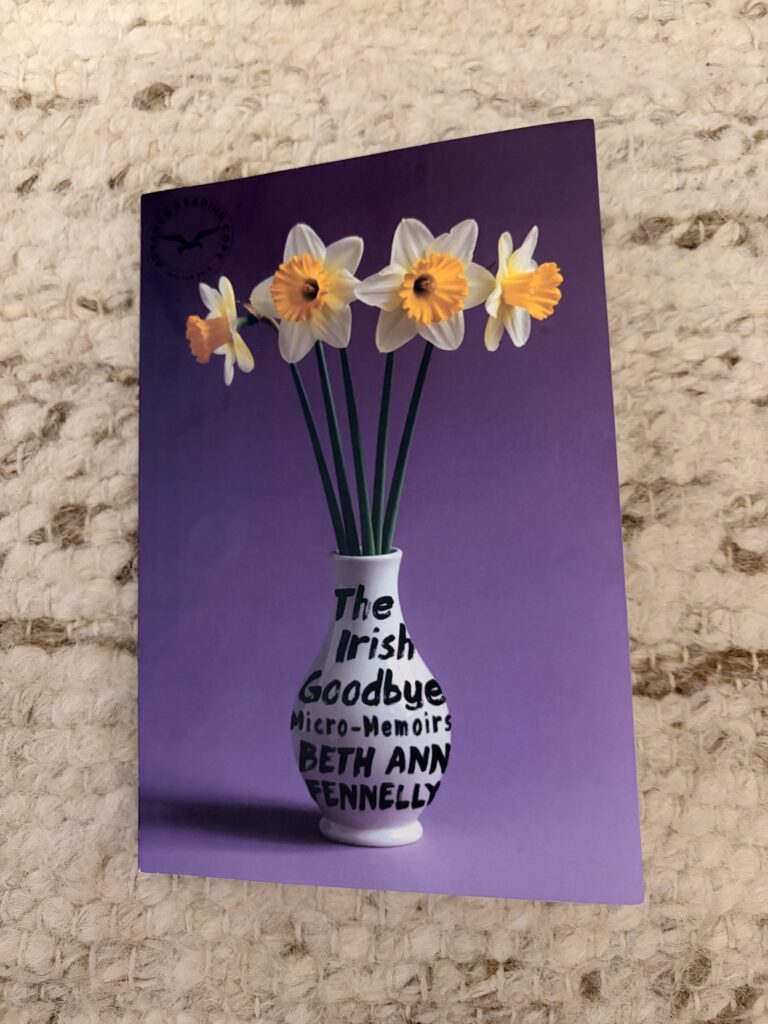
The Irish Goodbye: Micro-Memoirs
Genre: Nonfiction, essays
Grief focus: Death, addiction
Relationship: Sibling
Tone: Funny, companionable
Takeaway: Beth Ann Fennelly’s micro essays offer a slice of life that’s companionable and amusing with periodic gut punches as she circles around her sister’s death.
I don’t know. We’re all the main character in our own stories, surely, but sometimes the protagonist isn’t a single character. “The Irish Goodbye” is filled with short essays about numerous topics: recurring marriage vignettes, stories of caring for her mother-in-law and mother, anecdotes about teaching at the University of Mississippi, so much slice-of-life material that can make a middle-aged woman feel right at home. Fennelly is the main character of this collection, but here I am repeatedly returning to her sister. I bet she’d understand, though; it seems that her life follows the same trajectory.
It’s been nearly a decade since Cristin died. Occasionally, someone will tell me they didn’t know I’d lost a sibling. I’m shocked every time; Cristin’s death feels like a central fact of my life, the BCE and AD fulcrum of how I perceive time.
And yet, there’s so much of my life she didn’t get to know. She didn’t see me leave journalism or move back to Alabama. She never saw me as a homeowner, though she would be proud (and would keep my guest room in such a state that I’d be relieved when she left and took her mess with her). She didn’t see me in love—and she would have adored him herself—or console me in heartbreak.
And those are just my milestones. There are so many more relative to others (she never met either of our nieces!) and that would have been her own. Who can know what her life would have looked like, had it continued?
In the days following my sister’s death, I saw friends speculating about the cause rather than asking me. Their motives were probably pure. They may not have wanted to burden me when I was in both the depths of shock and sorrow. But that didn’t land well with me. I ignored what I saw, though I wasn’t shy about discussing Cristin’s cause of death with anyone who asked directly.
Fennelly seems similarly frustrated, recounting related searches that appear when you type her name into Google. Among them: “Beth Ann Fennelly sister.”
“The first time I saw this last related search, I was shocked. Shocked, but not for long,” she writes.
“When I thought about it, searching fo rmy sister made a lot of sense. After all, I’m also searching for my sister, though in a different way, of course. The reader, I assume, is simply searching for the manner of her death.”
On paper, Fennelly’s sister died of pneumonia. “But who dies of pneumonia, really, in their thirties, in the America of the Twenty-First Century,” she asks in the essay “Because My Editor Suggests I Reveal How My Sister Died.” Her sister’s autopsy doesn’t indicate contributing factors, which Fennelly knows as tobacco, alcohol, undernourishment.
My sister died of complications of chronic alcoholism. It’s right there on her autopsy, which I keep in the bookcase beside my desk. But surely her history of eating disorder didn’t help. Those folded papers from the city of New York’s chief medical examiner’s office includes a list of diagnoses which I understand to be related to both alcohol and the eating disorder she wrestled with in her 20s.
“I’ve always felt her death was at least 13% a suicide,” Fennelly writes, and I’ve felt the same about Cristin. “But maybe she didn’t choose death even a little bit, maybe she was just so used to getting away with everything, maybe she couldn’t believe she’d ever have to pay, flashing her devil-may-care grin over her shoulder as she fishtailed on her Big Wheel, leaving me behind in a spray of gravel, me always running, running to catch up.”
And maybe that’s right. Death by alcoholism seems to me, from the outside, like a choice, at least partly. But I also think Cristin was in denial. After she died, a friend of hers shared that Cristin’s doctor had told her she had to quit drinking or she’d meet her end. Cristin didn’t stop.
“The Irish Goodbye” isn’t all about Fennelly’s sister. That’s also not how life after loss works. Life marches on, with children and work and love and maybe a decision to pose for a nude portrait at age 51.
Her sister’s death tints all of Fennelly’s life that follows—or at least, that’s my experience. I could be projecting, and I don’t want to claim it’s universal. But comments about my dead sister can pop out at inopportune moments. She’s part of my history, and her memory will remain part of my present.
Note: I am a Bookshop.org affiliate, and I’ll receive a small payment if you shop using the links above. I also strongly recommend supporting your local bookstore! PS I also love Beth Ann Fennelly’s previous collection of micro-essays, “Heating & Cooling: 52 Micro-Memoirs.”