A singular grief can still resonate across circumstance
C.S. Lewis is generally considered a giant of the Christian faith. “The Chronicles of Narnia” are beloved by children and adults alike for their allegory and adventure. (I find the allegory too on nose, but that’s one woman’s hot take.) “Mere Christianity” is iconic, one of those books I found on everyone’s shelves, including my own, during my years as an evangelical. And though I still haven’t read it, it continues to occupy space in my home.
I considered myself a Christian for about 30 years and spent the last 12 of them in faithful, studied circles. My bookshelves and my CD case were influenced by the wares at Family Christian Stores, and for several years, Christian media was nearly all I consumed. Limp Bizkit, Fuel and Danielle Steel? Out. 4Him, FFH and Francine Rivers? In.
By the time I left the church in 2011, my shelves had diversified, but the “Christian” section remained substantial. I culled the titles, keeping about a dozen. Today, C.S. Lewis constitutes a third of my religion and spirituality collection.
Even so, it had been 18 years since I’d read Lewis’ nonfiction. I picked up “A Grief Observed” this month, and it felt like the first time.
A Grief Observed
Genre: Nonfiction, spiritual
Grief focus: Death
Relationship: Spouse
Tone: Gentle, blunt, reflective
Takeaway: There’s always something to learn from another’s experience, regardless of how it intersects with your own.
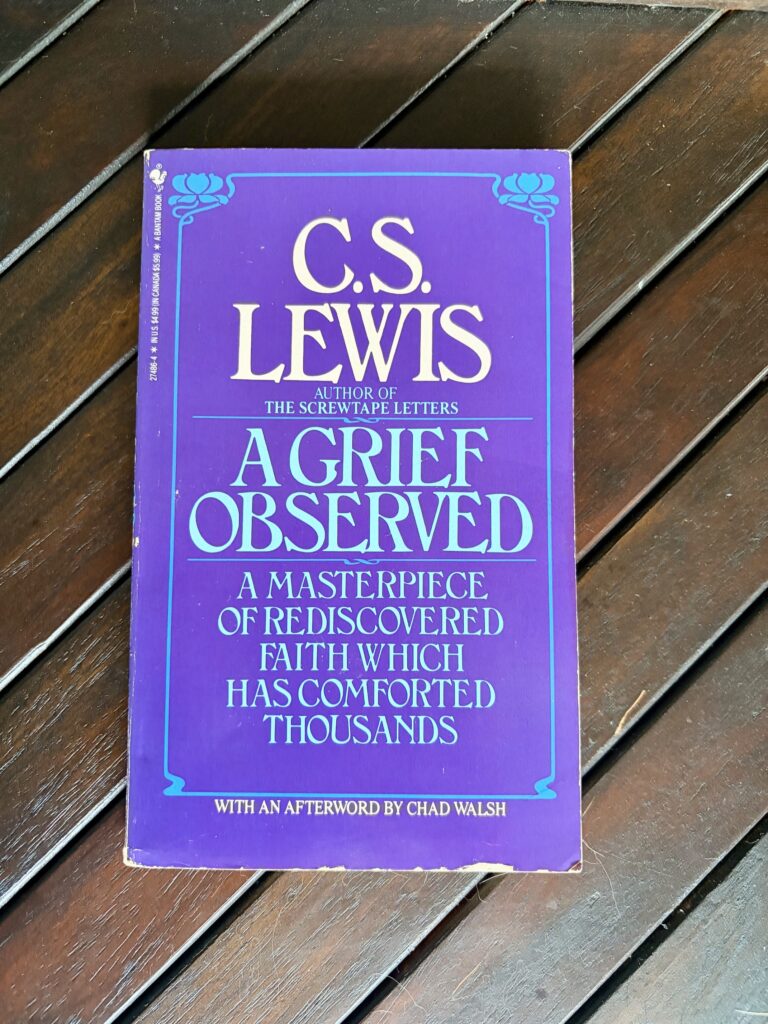
I last read this book in 2008. What did I know about grief back then? I’d suffered disappointments, for sure: men who didn’t want me, career moves that didn’t meet my expectations, years of untreated depression. But I wouldn’t say I’d experienced much grief.
Still, I rated the book five stars.
“A Grief Observed” is a short book, a collection of journal entries Lewis wrote after his wife’s death from cancer. But death of a romantic relationship can take several forms. For me, that’s been a significant breakup. Though it was six months ago, it’s shaped my year.
I’ve been careful in how much I write about that. Write for the scars, not the wounds, some say, and I ascribe to that philosophy. It’s better for both me and him.
I’ve journaled about him plenty, though, and had many heart-to-hearts with my girlfriends. But now, six months in, I’m starting to feel that the scabs are falling away to reveal fresh scars. That doesn’t change how I miss him, exactly. But it’s no longer so raw.
In “A Grief Observed,” Lewis’ anguish is raw, and that’s part of the text’s power. The book pulls from his journals in the months after his wife Joy’s 1960 death. The book first appeared in 1961 but under a pseudonym. Lewis was prepared to share his sorrow more publicly, though I don’t know whether the pseudonym was protecting him, little more than a year after Joy’s death, or his fans, who haven’t always reacted well to questioning faith.
Though Lewis’ anguish is unmistakable and his questions about God understandable, to me the book’s power isn’t its relationship to faith. Lewis’ cries resonate as he mourns an embodied love. The intimacies he recalls aren’t for a parent or a friend; they’re for the person who knew him best and loved him with both heart and body.
“I thought I could describe a state; make a map of sorrow. Sorrow, however, turns out to be not a state but a process,” he writes.
During the past six months, I’ve alternately longed to stop hurting and wanted to hold onto the pain because it’s evidence of a deep relationship, lost. But the fact is, yes, that sorrow is a process.
Some days are easier. Some days have been nasty, calling to mind Lewis’ next-day apology for the messiness of grief: “I wrote that last night. It was a yell rather than a thought.” But many days have simply been part of the process and recognition that neither grief nor healing is linear.
“Aren’t all these notes the senseless writhings of a man who won’t accept the fact that there is nothing we can do with suffering except to suffer with it?”
Lewis’ book is a grief observed, not a reflection on grief more broadly. But there’s always something to learn from another’s experience, regardless of how it intersects with your own.
Note: I am a Bookshop.org affiliate, and I’ll receive a small payment if you shop using the links above. I also strongly recommend supporting your local bookstore!